
- What Is Odoo CRM and Why UAE Businesses Need It
- 8 Proven Wins of Odoo CRM for UAE Businesses
- Odoo CRM vs. Generic CRM Tools
- Why UAE Businesses Are Moving to Odoo CRM
- How APPSGATE Implements Odoo CRM
- Frequently Asked Questions
What Is Odoo CRM and Why UAE Businesses Need It
Odoo CRM for UAE businesses is quickly becoming the standard way mid-sized and large companies across Dubai, Abu Dhabi, and the wider Emirates manage their sales pipelines. Instead of juggling spreadsheets, disconnected email threads, and sticky notes, sales teams get one centralized system to track every lead from first contact to closed deal.
For IT managers, CFOs, and general managers across the GCC, the appeal is simple: a single source of truth for customer relationships that connects directly to accounting, inventory, and operations. This is exactly the problem APPSGATE was built to solve — moving businesses away from manual processes toward centralized, automated operations using Odoo ERP.
UAE companies are not short on CRM options. What they are short on is a CRM that talks to the rest of the business. That is where Odoo CRM, implemented correctly, pulls ahead of point solutions that only manage contacts and nothing else.
In this guide, we’ll walk through what makes Odoo CRM for UAE businesses different, the real operational wins companies see after adoption, how it stacks up against generic CRM tools, and why the shift toward unified ERP-based CRM is accelerating across the region in 2026.
8 Proven Wins of Odoo CRM for UAE Businesses
Odoo CRM is not just a digital rolodex. When implemented properly, it reshapes how a sales team operates day to day. Here are eight proven wins UAE companies report after adopting Odoo CRM.

1. Centralized lead management
Every inbound lead — whether from a website form, a phone call, WhatsApp, or a referral — lands in one pipeline instead of being scattered across inboxes and personal notebooks. Sales managers finally get visibility into the full funnel.
2. Automated follow-ups
Odoo CRM can trigger automated email or activity reminders so no lead goes cold because someone forgot to follow up. This alone recovers deals that would otherwise be lost to simple human oversight.
3. Visual pipeline tracking
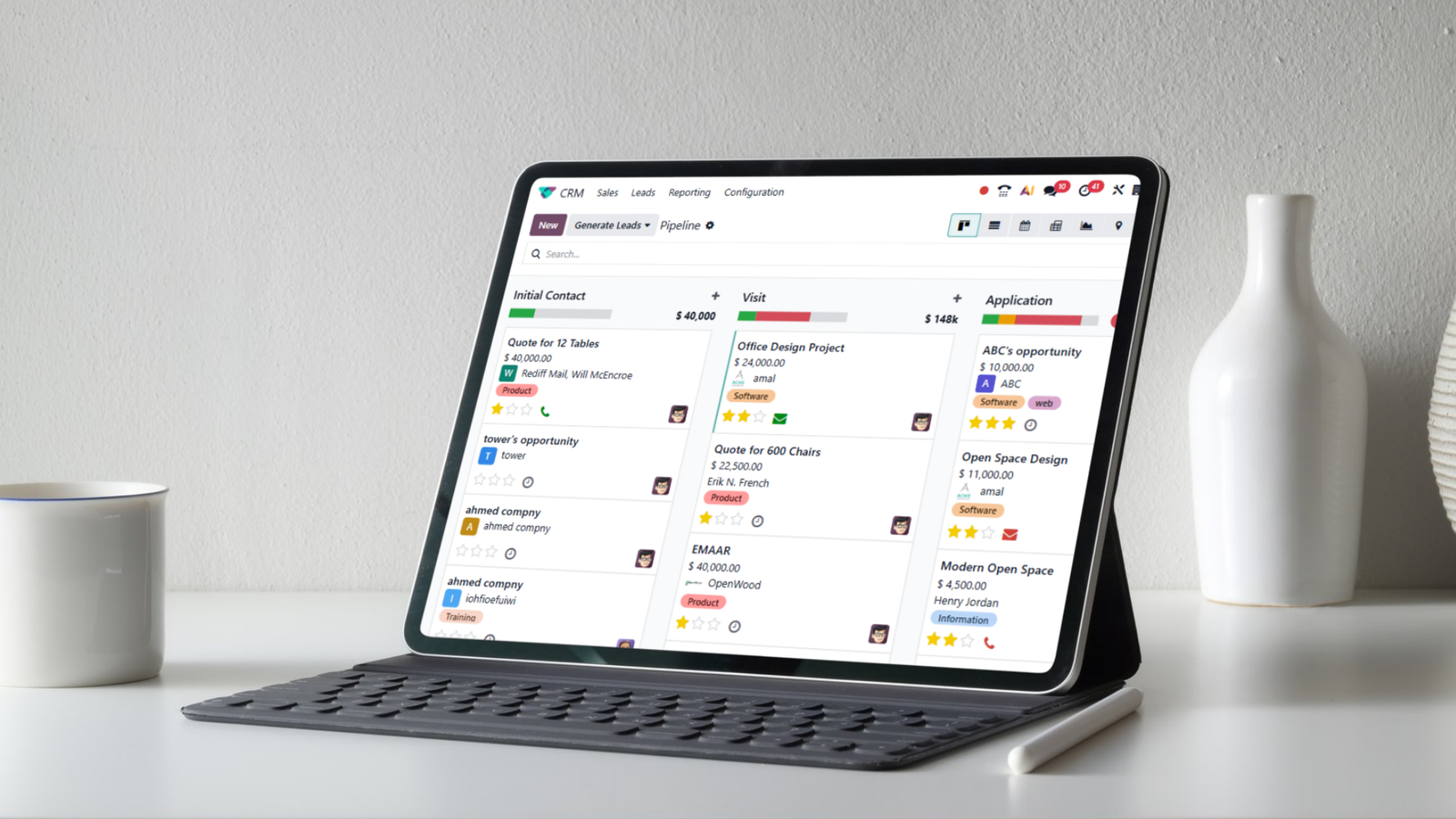
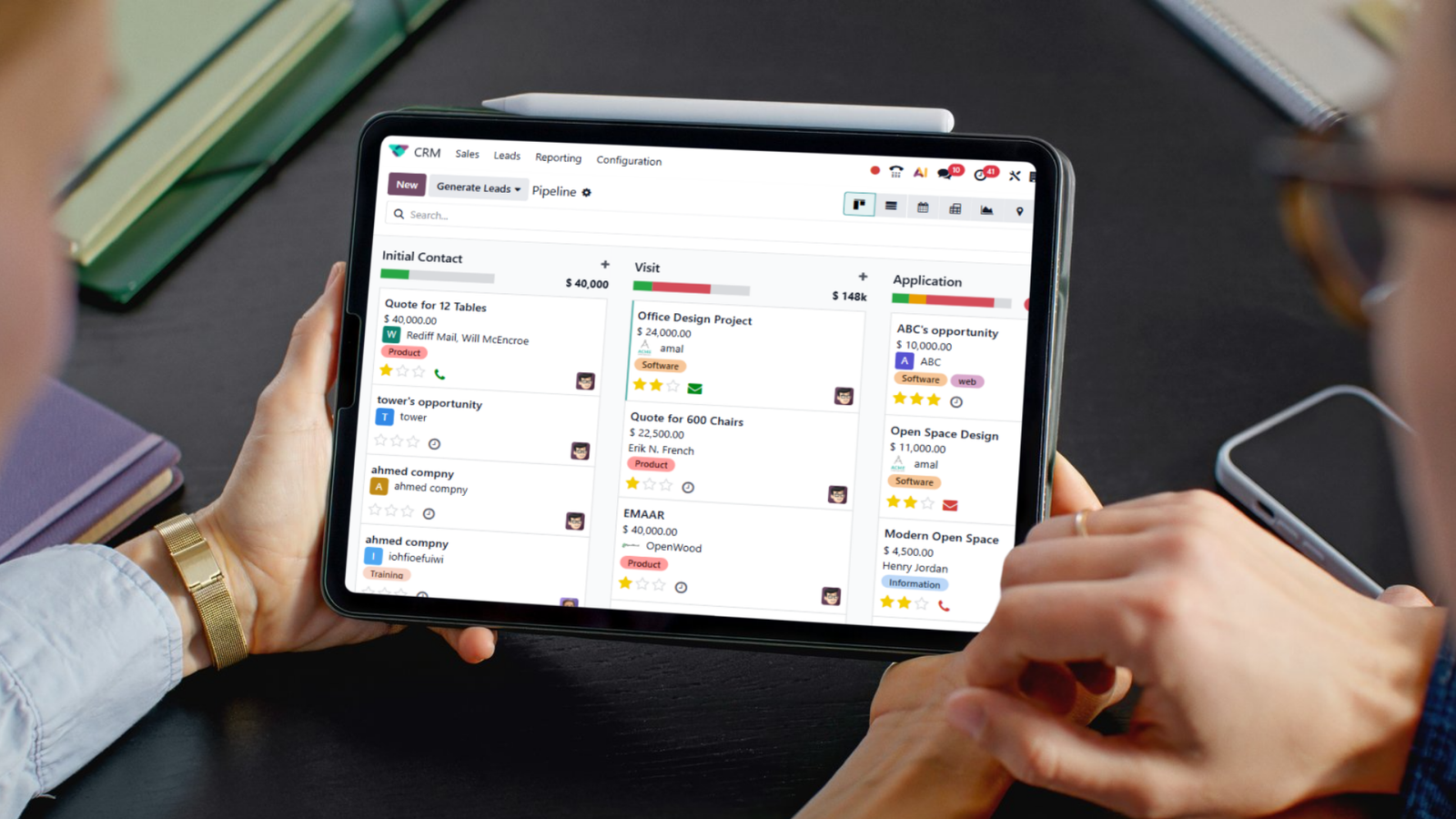
The drag-and-drop Kanban pipeline view lets sales reps and managers see exactly where every opportunity sits — new, qualified, proposal sent, negotiation, or won/lost — without a single status-update meeting.
4. Integrated quotations and invoicing
Because Odoo CRM sits inside the same platform as Odoo Sales and Accounting, a quotation can be generated directly from an opportunity and converted into an invoice once the deal closes, with no re-keying of data.
5. Real-time sales reporting
Management gets live dashboards on conversion rates, average deal size, sales cycle length, and team performance — critical data for CFOs and general managers who need to forecast revenue accurately.
6. Email and WhatsApp integration
Sales teams can log calls, sync emails, and even integrate WhatsApp conversations directly against a customer record, so the full communication history travels with the deal rather than living in someone’s personal phone.
7. Lead scoring and prioritization
Odoo CRM allows businesses to score and tag leads by quality, source, or likelihood to close, helping sales teams focus their energy on the opportunities most likely to convert rather than treating every lead equally.
8. Mobile access for field sales teams
UAE sales teams are rarely desk-bound. Odoo’s mobile app means a rep meeting a client in Business Bay or Sharjah can update an opportunity, log a call, or send a quote from their phone in real time.
Together, these wins explain why Odoo CRM for UAE businesses has moved from a “nice to have” to a core requirement for companies serious about scaling their sales operations in 2026.
Odoo CRM vs. Generic CRM Tools
Many UAE businesses start their CRM journey with a standalone tool — something cheap, quick to set up, and focused purely on contact management. The problem surfaces a few months in, once the business realizes the CRM doesn’t talk to anything else.
Standalone CRM tools typically offer:
- Contact and lead tracking
- Basic pipeline stages
- Email logging
- Limited or costly third-party integrations with accounting and inventory systems
Odoo CRM, by contrast, is built inside a full business platform, which means:
- Leads convert directly into quotations, sales orders, and invoices without manual re-entry
- Inventory availability can be checked while building a quote, avoiding overpromising stock
- Finance teams see revenue pipeline data without waiting on a CSV export from the sales team
- One login, one user directory, and one support relationship instead of five separate vendor contracts
This difference matters most for growing companies. A standalone CRM might feel sufficient at 10 sales reps, but once a UAE business scales toward 50+ employees across sales, finance, and operations, the cost of disconnected systems becomes obvious — duplicate data entry, reporting delays, and errors that creep in whenever information is copied by hand between tools.
According to Gartner’s research on CRM technology trends, organizations increasingly look for platforms that connect customer relationship data with broader operational systems rather than managing CRM in isolation — a trend that aligns closely with why Odoo’s unified approach resonates with GCC businesses. (Note to editorial: verify exact wording of this paraphrase against the live Gartner page before publishing.)
This is precisely the gap Odoo CRM closes, and it’s a major reason APPSGATE recommends it as the default CRM choice for clients already running — or planning to run — other parts of their business on Odoo.
Why UAE Businesses Are Moving to Odoo CRM
The shift toward Odoo CRM across the UAE isn’t happening in a vacuum. It’s tied to three broader trends reshaping how GCC companies buy software.
1. Consolidation over point solutions. CFOs and IT managers are increasingly wary of “tool sprawl” — paying for, securing, and maintaining a dozen disconnected SaaS subscriptions. Odoo CRM lets them retire a standalone CRM license while gaining tighter integration with finance and operations.
2. VAT and compliance pressure. With UAE VAT reporting requirements tightening, finance teams want sales data that flows directly into compliant accounting records without manual reconciliation. A CRM that’s part of the same system as accounting removes an entire category of reporting risk.
3. Regional growth and multi-branch operations. Many AppsGate clients operate across multiple Emirates or even multiple GCC countries. A cloud-based, centralized CRM means a sales manager in Abu Dhabi and one in Dubai are working from the exact same pipeline data in real time, with no sync delays.
4. Industry-specific needs. Real estate brokerages need commission tracking tied to CRM opportunities. Schools need admissions pipelines that look a lot like a sales funnel. Service businesses need job costing linked to the deals that generated the work. Odoo’s modular structure lets CRM extend naturally into these industry-specific workflows, which is exactly how AppsGate has approached solutions like real estate lead follow-up automation for property businesses.
5. Cost of ownership. Because Odoo CRM is part of a broader Odoo ERP license rather than a separate product, total cost of ownership is often lower than running a best-of-breed CRM alongside a separate ERP, once integration and maintenance costs are factored in.
These trends are converging in 2026, and UAE businesses that delay the move to a unified CRM risk falling behind competitors who already have cleaner data, faster quote-to-cash cycles, and better visibility into their sales pipeline.
How APPSGATE Implements Odoo CRM for UAE Businesses
APPSGATE doesn’t just install Odoo CRM and hand over a login. As a UAE-based Odoo consultancy, the approach is built around understanding how a specific business actually sells before any configuration begins.
The typical implementation process includes:
- Requirements analysis — understanding the current sales process, lead sources, and pain points specific to the client’s industry
- Pipeline design — configuring pipeline stages, lead scoring rules, and automation triggers that match how the sales team actually works
- Integration setup — connecting Odoo CRM to Sales, Accounting, Inventory, and where relevant, WhatsApp or email channels
- Data migration — moving existing contacts, deals, and history from spreadsheets or a legacy CRM without losing historical context
- Team training — hands-on training so sales reps and managers are comfortable with the new system from day one
- Ongoing support — ongoing support and refinement as the business grows and sales processes evolve
This matches AppsGate’s broader philosophy across every implementation, whether it’s a general Odoo CRM rollout, PropertyGate for a real estate brokerage, or EduGate for a school: analyze first, customize second, train thoroughly, and support continuously.
Because APPSGATE works across real estate, education, and general business sectors throughout the GCC, the team brings pattern-matched experience to each Odoo CRM implementation — configurations that have already proven effective for similar companies in similar industries, rather than a generic, one-size-fits-all setup.
Frequently Asked Questions
Is Odoo CRM for UAE Businesses suitable for small businesses, or only large enterprises?
Odoo CRM scales in both directions. Small teams benefit from the simplicity of a single pipeline view, while larger organizations benefit from its deeper integration with accounting, inventory, and HR as they grow.
Can Odoo CRM integrate with WhatsApp, which is widely used across the UAE?
Yes. Odoo CRM supports integration with WhatsApp and email so customer conversations can be logged directly against a lead or opportunity record, keeping the full communication history in one place.
How long does an Odoo CRM for UAE Businesses implementation typically take?
Timelines vary based on complexity, data volume, and how many systems need to be integrated, but a focused CRM rollout can often be completed faster than a full ERP implementation since it’s a more contained scope.