
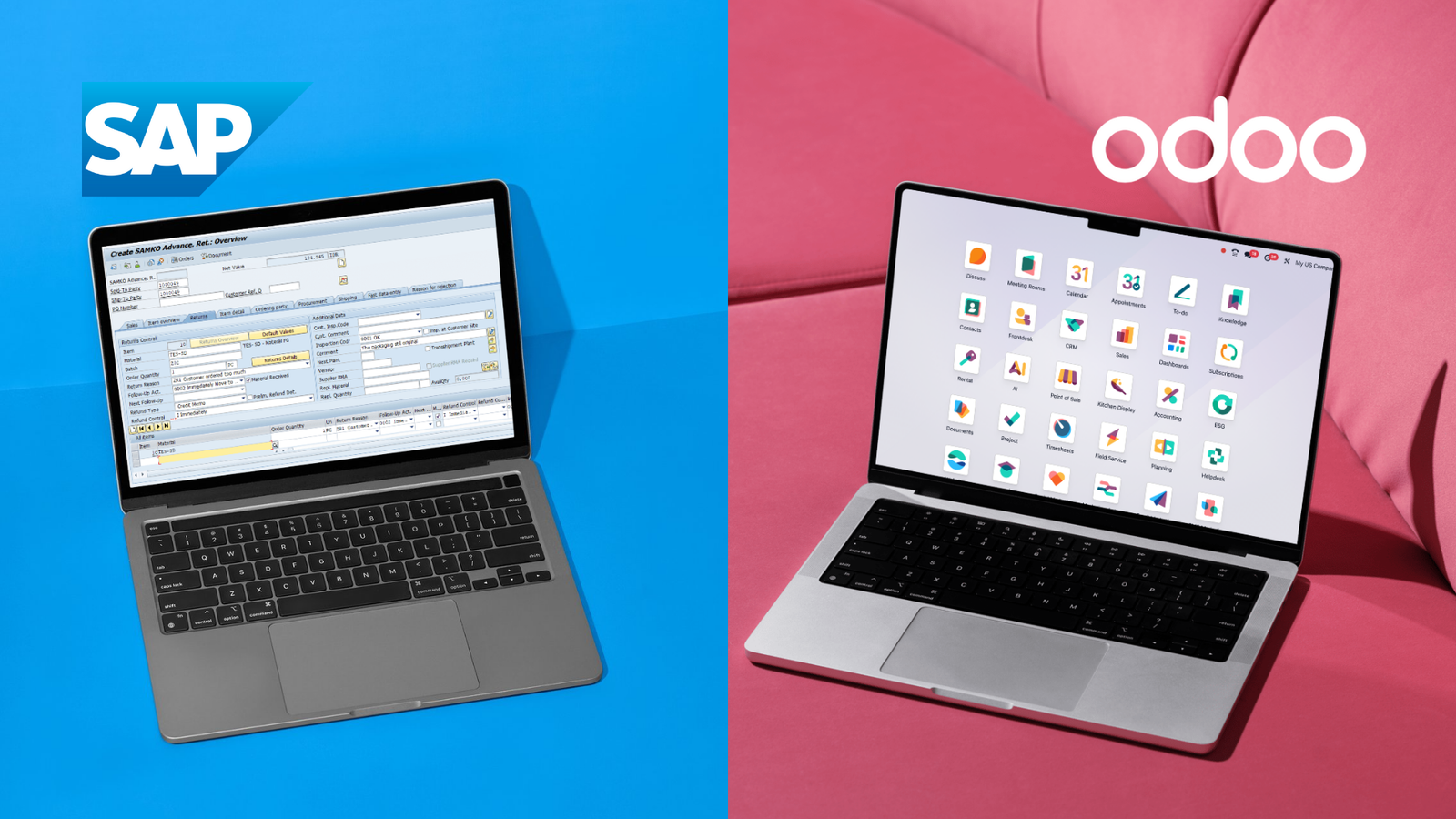
Choosing the right enterprise resource planning (ERP) system is one of the most important decisions a small or medium-sized enterprise (SME) in the UAE can make. ERP software powers core business processes — from accounting and inventory to HR and customer relationships — and plays a crucial role in operational efficiency, scalability, and strategic growth.
In the UAE’s competitive and rapidly evolving business environment, organizations need an ERP that not only streamlines operations but also supports compliance with local regulations like VAT, multi-currency transactions, and multi-company structures. Two of the most talked-about ERP solutions globally are Odoo and SAP. But when it comes to UAE SMEs, which one is the better choice?
This comprehensive comparative guide — Odoo vs SAP — explores every dimension of ERP software evaluation, helping UAE SMEs make an informed decision.
What Is ERP and Why It Matters for UAE SMEs

Before diving into the Odoo vs SAP debate, it’s important to define what ERP is and why it matters — especially in the UAE context.
An ERP (Enterprise Resource Planning) system integrates core business functions into a single platform. This includes:
- Finance & Accounting
- Human Resources
- Inventory & Warehouse Management
- Sales & CRM
- Manufacturing
- Procurement
- Reporting & Analytics
For UAE SMEs, a good ERP system:
- Reduces redundant processes
- Improves data accuracy
- Enables real-time decision-making
- Supports compliance with UAE tax and reporting regulations
- Augments scalability as the business grows
However, not all ERPs are created equal. That’s where an ERP comparison UAE becomes crucial.
Quick Overview: Odoo vs SAP
Here’s a snapshot comparison to anchor the deeper analysis that follows:
| Feature | Odoo | SAP |
|---|---|---|
| Target Market | SMEs & mid-market | Large enterprises & mid-market |
| Deployment | Cloud / On-Premise | Cloud / On-Premise |
| Licensing | Subscription / Open-Source | Proprietary |
| Customization | High | High (often complex) |
| Integration | Easy | Complex |
| Cost | Affordable | High |
| UAE Market Suitability | Excellent | Strong for large multi-national firms |
This table reflects broad tendencies — the rest of this article unpacks the details.
Odoo vs SAP: Core Differences Explained
1. Licensing & Cost Structure
One of the biggest differentiators in Odoo vs SAP is how the systems are licensed and priced.
Odoo:
- Offers an open-source Community edition and an Enterprise edition
- Costs are subscription-based with modular pricing — you pay for the users you need
- Generally affordable for SMEs
SAP:
- Typically uses a proprietary, user-based licensing model
- Licensing and implementation costs can run high, especially for SAP ECC or S/4HANA
- Best suited for large organizations with big budgets
Verdict:
For UAE SMEs with tighter ERP budgets, Odoo’s flexible licensing makes it more accessible and predictable in cost.
2. Deployment Options & Flexibility
Both Odoo and SAP support cloud and on-premise deployments, but they differ in flexibility:
Odoo:
- Cloud-ready out of the box
- On-premise option available
- Modular — you can add apps as your business grows
SAP:
- Cloud with SAP S/4HANA Cloud
- On-premise with SAP ECC or S/4HANA
- Strong enterprise cloud infrastructure but often requires implementation partners
Verdict:
Odoo’s modular and flexible deployment model typically fits SMEs better, letting them scale without huge upfront commitments.
3. Features & Modules
Both platforms offer extensive modules, but with different priorities:
Odoo:
- Strong core apps out of the box
- CRM, Accounting, Inventory, eCommerce, Project Management, HR
- Easy integration between modules
- Built for usability
SAP:
- Deep functionality for complex enterprise processes
- Strong in manufacturing, supply chain, finance
- Advanced analytics and reporting
Verdict:
SAP offers deeper functionality out of the box for large, complex enterprises. Odoo, however, delivers core SME needs with simplicity and flexibility.
User Experience & Usability
Odoo User Interface
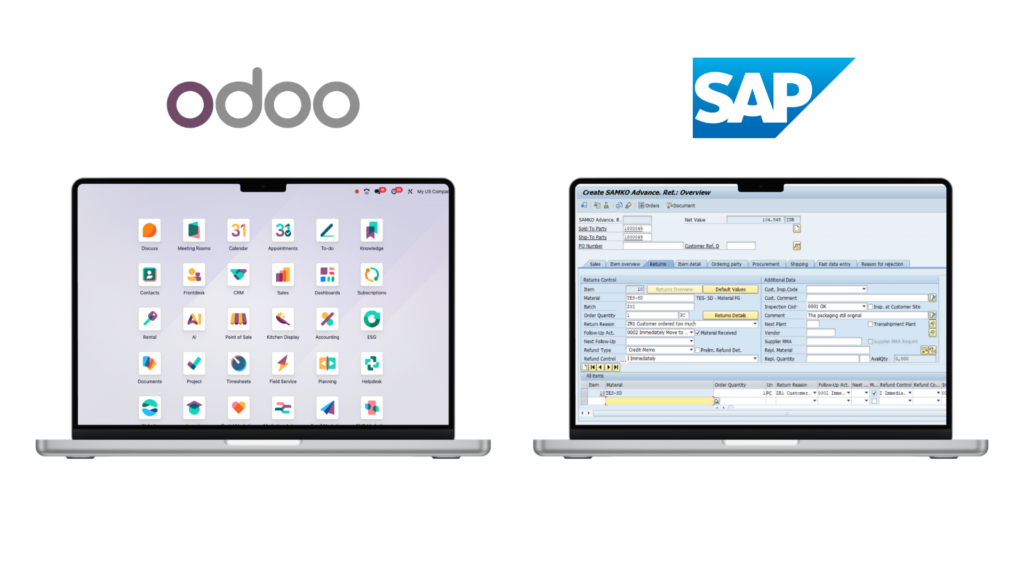
Odoo’s UI is modern, clean, and user-friendly. UAE SME teams — whether finance, sales, or operations — can start using the system with minimal training. Its modular app store structure makes adoption incremental rather than overwhelming.
SAP User Interface
SAP’s interface, especially in older versions like SAP ECC, is more complex and geared toward power users. SAP Fiori (the newer UX) improves usability but still requires training.
Verdict:
For SMEs in the UAE, Odoo typically provides a faster learning curve and higher user adoption rate.
Customization & Integration
Customization
Both Odoo and SAP allow deep customization, but the effort and cost differ:
- Odoo: Easier to customize due to open-source architecture
- SAP: Highly customizable, but often requires specialist developers
Integration
- Odoo: Integrates easily with third-party tools via APIs — ideal for modular growth
- SAP: Integration is powerful but typically more complex and project-driven
Verdict:
Odoo simplifies customization and integration for SMEs, while SAP’s strength lies in complex enterprise ecosystems.
Scalability & Future Growth

Odoo
Odoo scales well within the SME and mid-market segment. It supports multi-company setups, multi-currency transactions, and advanced workflows as businesses expand. For many growing UAE firms, Odoo remains manageable and cost-effective even as complexity increases.
SAP
SAP is built for large enterprise scalability — global operations, massive data volumes, and advanced compliance. It is often chosen by multi-national corporations or industries with extreme complexity.
Verdict:
For UAE SMEs with aspirations to grow, Odoo delivers scalable ERP without the enterprise price tag.
Compliance & Localization for the UAE
ERP systems must support local compliance — especially VAT, multi-currency transactions, and regulatory reporting.
Odoo in the UAE
Odoo can be localized for UAE VAT and financial reporting. Many UAE partners (including APPSGATE) implement compliant accounting charts, VAT workflows, and reporting templates tailored to local laws.
SAP in the UAE
SAP also offers localization for VAT and compliance, but implementation is usually more complex and project-based.
Verdict:
Both systems support UAE compliance, but Odoo’s ease of configuration gives it an edge for fast, low-risk deployment in SME contexts.
Implementation Time & Cost
Odoo Implementation
- Faster deployment cycles
- Lower overall implementation costs
- Iterative go-lives are possible
- Less need for extensive training
SAP Implementation
- Longer deployment timelines
- High implementation and consulting fees
- Requires certified SAP consultants
- Longer change management periods
Verdict:
Odoo’s speed and cost advantages are significant for SMEs that need results quickly and within budget.
Support & Ecosystem
Odoo
- Strong community support
- Large global partner network
- Local UAE partners offer implementation and support
- Easier to find UAE-based developers and consultants
SAP
- Extensive global support
- Enterprise partners and consulting houses
- Support available but often costly and highly structured
Verdict:
Odoo delivers accessible support options for SME budgets, while SAP excels in enterprise ecosystems.
Total Cost of Ownership (TCO)
When comparing Odoo vs SAP, SMEs must assess not just software licenses, but total cost of ownership.
Odoo typically has:
- Lower license costs
- Lower implementation costs
- Lower support and maintenance expenses
SAP, on the other hand, demands:
- Higher upfront licensing
- Expensive consulting engagements
- Higher support costs over time
Verdict:
Odoo typically offers a significantly lower TCO — a critical factor for UAE SMEs.
Best Use Cases: When to Choose Odoo
Odoo is ideal for UAE SMEs that:
- Are budget-conscious
- Need fast deployment
- Prefer a modular approach
- Want easy customization
- Value user-friendly UX
- Have simple to moderately complex processes
- Plan to scale gradually
Example SME scenarios where Odoo fits well:
- Retail companies with omnichannel needs
- Small manufacturers
- Professional services firms
- Distribution companies
- Startups and tech firms
Best Use Cases: When SAP Might Be Better
SAP makes sense for:
- Large enterprises with highly complex operations
- Multi-national corporations
- Industries with stringent compliance or industry standards
- Organizations with existing SAP ecosystems
Examples:
- Global manufacturers with multi-site production
- Financial institutions with complex audit requirements
- Large supply chain networks
Why Many UAE SMEs Prefer Odoo

Over the past decade, Odoo has gained strong traction among SMEs across the UAE. While global ERP giants like SAP dominate large enterprises, Odoo has positioned itself as the ERP of choice for small and medium-sized businesses that need flexibility, speed, and value. Here’s a deeper look at why Odoo consistently wins SME adoption in the UAE.
1. Cost-Effectiveness Without Compromising Capability
Cost is one of the most decisive factors for UAE SMEs when selecting an ERP system. Unlike enterprise-grade solutions that require significant upfront investment, Odoo offers a modular and affordable pricing model that aligns well with SME budgets.
UAE SMEs benefit from:
- Lower licensing costs compared to SAP
- The ability to pay only for required modules
- Reduced implementation and customization costs
- Lower long-term maintenance and support expenses
This makes Odoo a financially sustainable ERP solution, especially for growing businesses that want enterprise-level functionality without enterprise-level costs. The lower total cost of ownership allows SMEs to invest more in growth, marketing, and operations rather than software overhead.
2. Faster User Adoption and Minimal Training
One of the biggest challenges with ERP systems is user resistance. Complex systems slow down adoption, increase training costs, and reduce ROI. Odoo addresses this challenge with a clean, modern, and intuitive user interface.
For UAE SMEs, this means:
- Employees adapt faster with minimal ERP training
- Departments such as sales, accounting, and operations can work efficiently from day one
- Reduced dependency on IT teams for daily operations
- Higher productivity and fewer operational errors
This ease of use is particularly important in the UAE, where businesses often have diverse, multicultural teams with varying technical backgrounds.
3. Mobile and Remote Accessibility for Modern Workforces
UAE businesses increasingly operate across multiple locations, free zones, and even countries. Odoo’s cloud-ready architecture makes it ideal for modern, mobile work environments.
With Odoo, UAE SMEs can:
- Access the ERP securely from anywhere
- Enable remote work for finance, sales, and management teams
- Monitor real-time dashboards on mobile devices
- Manage approvals, reporting, and operations without being office-bound
This flexibility became especially critical post-pandemic and continues to be a competitive advantage for agile SMEs.
4. Tailored Local Implementations for the UAE Market
ERP systems must align with local regulations and business practices to be truly effective. Odoo’s flexibility allows it to be fully localized for the UAE, especially when implemented by experienced local partners.
UAE SMEs benefit from:
- UAE VAT-compliant accounting setups
- Support for Arabic and English interfaces
- Multi-currency transactions for international trade
- Custom reports aligned with local regulatory requirements
- Workflows adapted to UAE business practices
Local implementation partners ensure that Odoo is not just installed, but properly configured to meet compliance, reporting, and operational standards in the UAE.
5. Scalable, Modular Growth Aligned with SME Journeys
Unlike rigid ERP systems that force businesses to implement everything upfront, Odoo allows SMEs to start small and scale intelligently.
Typical growth paths include:
- Starting with accounting and CRM
- Adding inventory, purchasing, or HR modules as the business expands
- Implementing manufacturing, project management, or eCommerce when needed
- Enabling multi-company setups as the organization grows
This modular scalability ensures that Odoo grows alongside the business, without unnecessary complexity or cost at early stages.
Why This Matters in the Odoo vs SAP Debate
In the context of Odoo vs SAP, these advantages explain why Odoo is often the more practical choice for UAE SMEs. While SAP excels in large, highly complex enterprise environments, Odoo offers the right balance of power, simplicity, and affordability for small and medium-sized businesses.
For UAE SMEs seeking:
- Faster ROI
- Easier adoption
- Local compliance
- Long-term scalability
Odoo consistently proves to be the better-aligned ERP solution.
Odoo vs SAP: Security & Data Governance
Security is critical for business continuity and compliance.
Odoo
Odoo provides:
- Role-based access control
- Secure cloud hosting options
- Data encryption
- Regular updates via cloud or on-premise
SAP
SAP’s security is robust and enterprise-grade — ideal for large organizations with complex compliance requirements.
Verdict:
Both platforms are secure, but Odoo’s security model is easier for SMEs to manage without large IT teams.
Partner Ecosystem: Choosing the Right Implementation Partner
ERP success depends heavily on the partner you choose.
For UAE SMEs looking at Odoo:
- Choose partners with local UAE experience
- Ensure familiarity with VAT compliance
- Look for strong support and training capabilities
- Prefer partners with end-to-end services, not just implementation
APPSGATE specializes in Odoo implementation, customization, and long-term support — helping UAE SMEs not just deploy software, but transform operations. Read more about our success stories on our Clients page.
Getting Started: ERP Selection Tips for UAE SMEs
- Define business goals first
Establish what problems you want the ERP to solve. - Assess your processes
Map current vs. desired workflows. - Estimate budget realistically
Include license, implementation, training, and support costs. - Prioritize scalability
Choose ERP that grows with your business. - Evaluate partners carefully
Local knowledge matters. - Run pilot tests
Try small process deployments before full implementation. - Invest in training
User adoption drives ROI.
Conclusion: Odoo vs SAP — Which Is Right for UAE SMEs?
When it comes to Odoo vs SAP, the answer depends on the size, complexity, and growth ambitions of the business.
For most UAE SMEs, Odoo emerges as the best fit because:
- It delivers comprehensive ERP capabilities at affordable pricing
- It supports UAE compliance requirements
- It offers fast implementation
- It scales modularly
- It drives high user adoption
- It minimizes total cost of ownership
SAP remains an excellent choice for large enterprises or highly complex organizations with enterprise-grade requirements.
Ultimately, the right ERP is the one that aligns with your organization’s strategic goals, operational needs, and growth trajectory. For most UAE SMEs today, Odoo offers the perfect mix of power, flexibility, and affordability.
APPSGATE is a leading ERP and enterprise software consulting firm specializing in Odoo implementation, customization, and support across the UAE. As an Odoo Partner, APPSGATE helps SMEs and growing enterprises streamline operations, improve visibility, and scale efficiently through tailored ERP solutions.
With deep industry expertise across real estate, manufacturing, healthcare, education, retail, and professional services, APPSGATE delivers business-first Odoo solutions that align technology with real operational needs. Backed by a 100% project success record and a strong local presence, APPSGATE stands out for its hands-on approach, reliable support, and long-term partnership mindset.